Sunday, July 12, 2026

William Pace: A Soldier in George Washington’s Commander-in-Chief’s Guard


The Fourth of July has passed, but the 250th anniversary of American independence is much bigger than a single day. America 250 gives us an opportunity to remember the ordinary men and women whose sacrifices carried the country from a declaration of independence on paper to independence in fact.

One of those men was our sixth great-grandfather, William Pace of Virginia, who served for most of the Revolutionary War in an unusually trusted military unit: General George Washington’s Commander-in-Chief’s Guard, commonly called Washington’s Life Guard.

From Virginia to Washington’s Headquarters

William Pace enlisted on January 23, 1777, in Captain Henry Conway’s company of the 14th Virginia Regiment, commanded by Colonel Charles Lewis.

Only a few months later, in May 1777, he was transferred at Morristown, New Jersey, to the Commander-in-Chief’s Guard under Captain Caleb Gibbs. Records differ slightly on whether the transfer occurred on May 6 or May 8, but they agree that William joined the Guard early that month and remained connected with it for the rest of the war.

The transfer placed him close to the center of the Continental Army.

The Guard protected General Washington, but its responsibilities went far beyond serving as a personal bodyguard. Its soldiers guarded army headquarters, Washington’s baggage, military papers, money, equipment, and the people who worked within headquarters. They stood sentry, controlled access to the commander-in-chief, accompanied Washington and important visitors, and helped secure headquarters whenever the army moved.

This was not simply a ceremonial honor guard. The men remained active soldiers and accompanied Washington’s army during military campaigns.

What kind of soldiers were chosen?

Washington established the Commander-in-Chief’s Guard in March 1776. His surviving orders show that he wanted men known for:

  • honesty;
  • sobriety;
  • good behavior;
  • cleanliness and neatness;
  • physical fitness and military bearing;
  • previous military training; and
  • willingness to serve in the Guard.

Each regiment was asked to nominate several men for consideration. Washington preferred men approximately five feet eight inches to five feet ten inches tall, describing them in the language of the time as “handsomely and well made.”

The candidates were instructed to appear without their uniforms or weapons, which may have allowed officers to judge their natural appearance and bearing rather than the condition of their military clothing and equipment.

Some family accounts say that members of the Guard also had to be married landowners and that Washington personally interviewed each candidate. I have not found those requirements in Washington’s original written orders, so I would not treat them as certain. The qualities that are documented—honesty, sobriety, discipline, neatness, fitness, and good behavior—already show that the Guard was intended to include dependable men.

William Pace’s selection suggests that his officers considered him trustworthy enough to serve close to the commander-in-chief and to protect information and property that could affect the entire Continental Army.

What might William’s life in the Guard have been like?

We cannot know William’s personal thoughts or feelings, but we can form a careful picture of his daily life from what is known about the Guard.

Much of his service probably involved routine sentry duty. He may have guarded roads, entrances, tents, houses, baggage wagons, military papers, and supplies. He may have checked the identity of people approaching headquarters or stood watch while Washington met with officers, messengers, foreign visitors, or political leaders.

The work was not always dramatic. Guard duty often meant long hours of standing, waiting, and remaining alert through darkness, rain, snow, mud, summer heat, hunger, and exhaustion.

Falling asleep while on sentry duty was treated as a serious offense because one careless guard could expose headquarters to theft, surprise attack, or espionage.

Although William served near Washington, his own living conditions would still have been those of an enlisted soldier. He would have experienced shortages of food, clothing, shelter, medicine, and pay. Being stationed near the commander-in-chief did not protect the Guardsmen from the hardships faced by the rest of the army.

Illness Early in His Service

William’s service record states that he was sick in the hospital during June and July 1777, only weeks after joining the Guard.

That brief entry on a muster roll may represent a dangerous period in his life. Disease and infection killed more Revolutionary War soldiers than combat did. Military hospitals were often overcrowded, poorly supplied, and vulnerable to outbreaks of illness.

William recovered and returned to duty in time to take part in the campaigns later that year.

The Battle of Brandywine

On September 11, 1777, William was present during the Battle of Brandywine in Pennsylvania.

Washington’s army attempted to stop British forces from advancing toward Philadelphia. The British outmaneuvered the Americans and forced them to withdraw, but the Continental Army was not destroyed.

As a member of the Guard, William may have helped protect Washington, headquarters personnel, papers, or baggage during the battle and the difficult retreat that followed. The Guard also fought when necessary, so his role was not necessarily limited to standing behind the lines.

The Battle of Germantown

Only a few weeks later, on October 4, 1777, William was present at the Battle of Germantown.

Washington attempted a complicated surprise attack on British troops occupying the area near Philadelphia. Fog, smoke, confusion, and poor coordination caused the American attack to break down.

Although Germantown ended in defeat, the willingness of the Continental Army to attack so soon after Brandywine impressed some foreign observers and demonstrated that Washington’s army was still capable of fighting.

The Winter at Valley Forge

During the winter of 1777–1778, William Pace was with the army at Valley Forge.

Valley Forge was not the site of a major battle, but it became one of the most important tests of the Continental Army. Soldiers suffered from shortages of food, clothing, shoes, blankets, and medical supplies. Disease spread through the camp, and many soldiers died.

The Commander-in-Chief’s Guard was quartered near Washington’s headquarters so its members could protect him, his staff, and his records.

During that winter, Baron Friedrich von Steuben introduced a more organized system of military drill. The Commander-in-Chief’s Guard and other selected soldiers were used to demonstrate his methods before the training was spread throughout the army.

It is possible that William saw or participated in this training. We cannot claim that he personally served in every demonstration without more specific evidence, but he belonged to the unit closely associated with von Steuben’s early training efforts.

William’s original enlistment eventually expired, but he reenlisted and continued serving. After surviving illness, battle, and the winter at Valley Forge, he chose—or accepted the obligation—to remain in the army for the duration of the war.

The Battle of Monmouth

William was present at the Battle of Monmouth in New Jersey on June 28, 1778.

The battle was fought in intense summer heat as Washington’s army attacked the British during their withdrawal from Philadelphia toward New York.

Monmouth ended without a clear victory for either side, but it demonstrated how much the Continental Army had improved. The troops performed with greater discipline than they had shown during the previous year’s battles.

For William, the day would likely have involved exhausting marching, confusion, smoke, noise, heat, and the need to protect headquarters while remaining ready to fight.

Furlough and Return to Service

William reenlisted and received a furlough in January 1779. His service chronology says that he later rejoined the Guard on September 1, 1779.

A furlough may have allowed him to return temporarily to Virginia, although the surviving summary does not tell us precisely where he went or what he did during that time.

What is clear is that he returned to military service and remained with the army through the final years of the Revolution.

Connecticut Farms

On June 7, 1780, William was present during the fighting at Connecticut Farms, now part of Union Township, New Jersey.

British and Hessian forces advanced toward the American positions near Morristown in an attempt to threaten Washington’s army and military supplies.

The Americans resisted the advance, and the British eventually withdrew. The campaign showed that, even several years into the war, Washington’s headquarters and the army’s supply network remained vulnerable.

King’s Bridge

William’s service record also places him at the skirmish or operation at King’s Bridge, New York, on July 3, 1781.

King’s Bridge stood at the northern end of Manhattan Island and was an important route into British-held New York City.

During the summer of 1781, Washington created the impression that he intended to attack New York. Meanwhile, American and French forces were preparing for the movement south that would eventually lead to Yorktown.

William, as a member of the Guard, would have moved with Washington’s headquarters during this period of secrecy, planning, and rapid military movement.

Yorktown

William was present during the Yorktown campaign in Virginia in the fall of 1781.

At Yorktown, American and French forces trapped the British army commanded by General Charles Cornwallis. French naval forces prevented the British from escaping or receiving help by sea.

After weeks of siege operations and bombardment, Cornwallis’s army surrendered on October 19, 1781.

The surrender did not formally end the Revolutionary War, but it effectively ended major British offensive operations in the United States.

For William, Yorktown may have carried special meaning. After years of service far from home, he had returned to Virginia as part of the army that secured the war’s decisive victory.

Service after Yorktown

William did not leave the army immediately after Yorktown.

The British still occupied New York City, the peace treaty had not yet been completed, and the Continental Army had to remain prepared in case negotiations failed or fighting resumed.

William continued serving until 1783.

On June 4, 1783, he was promoted to sergeant, an indication that after years of service he had earned additional responsibility and the confidence of his officers.

Two days later, at Newburgh, New York, he was furloughed while the army waited for the final peace arrangements.

William Pace was formally discharged on November 3, 1783.

By that time, he had served for nearly seven years—from the uncertain winter of 1777 through major campaigns in Pennsylvania, New Jersey, New York, and Virginia, and into the final months of the Continental Army.

Our Family Connection


William Pace’s story comes through Grandpa Aldridge’s family line.

Grandpa Aldridge’s paternal grandmother was Mary Elizabeth Jane Bellamy. William Pace was her second great-grandfather, making him our sixth great-grandfather.

This branch of the family had deep roots in Scott County, Virginia, where William lived after the Revolution and where later generations of our family also lived.

Knowing the exact family connection makes his story feel more personal. He is not simply a name in a military record, a history book, or an application to a lineage society. He is one of the people whose life and choices became part of our own family story.

The William Pace Memorial Bridge


William Pace is also remembered in Scott County through the William Pace Memorial Bridge.

The bridge is located on Virginia Route 632 near the Yuma community and Jones Cemetery, where William is buried. The Commonwealth of Virginia officially approved the bridge’s commemorative name in 2004.

The bridge was not one that William used during his lifetime. It was named in his honor nearly two centuries after his death as a memorial to his Revolutionary War service.

Its location is fitting. It stands in the same part of Virginia where William settled and where several generations of his descendants lived.

Remembering William Pace

William Pace did not become a famous general, politician, or statesman. His name survives in military records, muster rolls, family histories, lineage applications, a cemetery memorial, and the bridge that now bears his name.

That may be exactly why his story matters.

The American Revolution depended upon men who stood watch through the night, marched while hungry and exhausted, endured disease, guarded wagons and papers, fought in difficult battles, reenlisted after their original terms expired, and remained in service even after the victory at Yorktown.

William’s position in the Commander-in-Chief’s Guard placed him unusually close to George Washington, but he was still an enlisted soldier. His service required years of discipline, patience, courage, and sacrifice.

His selection for the Guard suggests that he was known as a dependable man. His promotion to sergeant near the end of the war suggests that he continued to earn the trust of his officers.

As our country commemorates 250 years since the Declaration of Independence, I am grateful to know the name and story of one of the men who helped defend that declaration:

Sergeant William Pace of Virginia, soldier of the Continental Army, member of George Washington’s Commander-in-Chief’s Guard, and my sixth great-grandfather.

His life reminds me that independence was not secured in a single battle or moment. It was achieved through years of ordinary duties performed faithfully under extraordinary circumstances.

Sunday, April 26, 2026

The Lost Years of David Miller: What I Learned About Mary Miller Harrison's Father


  This is a picture of David John Miller and Mary Hamilton.  They were the parents of David Miller.  According to Grandpa Harrison, there are no existing pictures of his grandfather because it was lost in a house fire.

For many years, our family knew only fragments about the father of Mary Miller Harrison, the mother of Grandpa Albert Harrison. We knew his name was David Miller. We knew he was born in Scotland. We knew that Mary’s mother died when Mary was a little girl, and that Mary was then raised partly by relatives and partly by other families. We also knew that later in life Mary warned her son (Grandpa Harrison) about alcohol because of the example of her father.

Beyond that, David Miller was mostly a mystery.

Recently, through census records, death records, and old newspapers, a fuller and more human story has begun to emerge.

A Young Family from Scotland

David Miller was born in Scotland, likely in Beith, Ayrshire, though later records list other places such as Glasgow or Aberdeen. Like many in our family lines, the Millers joined The Church of Jesus Christ of Latter-day Saints and emigrated to Utah.

David and his wife Jennie (Jeanette/Janet, sometimes recorded as Jane) Bailey Miller settled in Salt Lake City. Their daughter Mary Miller was born in 1873, and a son, Moroni David Miller, was born in November 1878.

At that time, David worked as a baker, reportedly at the Deseret Bakery.

The Tragedy That Changed Everything

Just weeks after Moroni was born, disaster struck.

Newspaper accounts from late December 1878 reported a “mysterious poisoning” in the Miller household in Salt Lake City’s 15th Ward. David had been working overnight at the bakery. When he returned home, he found his wife, a young hired girl, and the children overcome and unconscious.

Later reports concluded that Jennie Miller died from arsenical poisoning caused by gases from burning impure coal.

Mary, then a small child, survived. Baby Moroni survived. But the family was shattered.

Mary’s Childhood

After her mother’s death, Mary went first to live with her grandmother in Willard, Utah. Later she lived with another family in Salt Lake City, and then spent nine years with Joseph and Helen Argyle in Bountiful, Utah.

There she eventually met William Harrison, whom she married.

This helps explain the family stories that Mary had been “raised by strangers.” Like many children of that era who lost a parent, she was cared for in several homes.

What Happened to David?

For a long time, David Miller seemed to disappear.

We now know that he lived on, but under difficult circumstances. By the 1890s he was in Montana. Newspaper accounts from Butte, Montana, in February 1898 tell the story of his final days.

David had been working as a cook for a construction company at the Big Hole dam. He became seriously ill and tried to return to Butte for treatment. He was so weak that he could not continue traveling from Silver Bow Junction. A deputy sheriff named Gavin helped him, even taking him into his own home temporarily before bringing him into town.

Officials attempted to send David to the county hospital (sometimes called the poor farm), but he died before help could arrive.

Reports describe him as poorly dressed, carrying only $5.90 and some horehound cough candy. The official cause of death was given as bronchitis or pneumonia.

He Was Not Forgotten

At first, authorities did not know where his family was. Newspapers printed notices asking for help locating relatives in Utah.

Soon afterward, an undertaker in Butte received a telegram from David’s brother in Salt Lake City, who said he would come and arrange the funeral. Reports also noted that David’s mother was living in Willard, Utah.

Though David’s life seems to have become difficult and unsettled, he was not entirely forgotten. In the end, family came for him.

A More Complete Story

It would be easy to reduce David Miller to only his failures or hardships. But records now show a more complicated life:

  • A Scottish immigrant who came west with hope
  • A baker supporting a young family in Salt Lake City
  • A husband who lost his wife suddenly in a terrible accident
  • A father whose children were scattered after tragedy
  • A man who continued working for years afterward
  • A sick laborer who died far from home, but whose family still answered the call

His daughter Mary went on to build a family of her own and became the ancestor through whom we descend.

Why This Matters

Family history is rarely simple. Sometimes people who seemed to vanish were carrying burdens we never knew about. Sometimes a person remembered only as a cautionary tale had also known grief, hard work, endurance, and loss.

David Miller’s story reminds us that our ancestors were not legends or labels. They were real people, with broken places and redeeming ones too.

Aunt Beth: A Life Richer Than Many of Us Knew


After Aunt Beth’s passing, I began gathering family memories and searching old records to learn more about her life. What emerged was the story of an accomplished, generous, and remarkable woman whose life reached farther than many of us may have realized.

Aunt Beth was born in Wichita, Kansas, on June 9, 1945, the oldest of three sisters: Aunt Beth, Aunt Jan, and Mom. She grew up in Wichita and showed gifts early in both academics and music.

One especially interesting discovery was a 1954 Wichita newspaper article from the era of the Salk polio vaccine trials. It appears to show eight-year-old Aunt Beth participating in the testing program, calmly giving a blood sample as part of an important moment in American medical history. During a time when polio deeply frightened families, children like Aunt Beth and her parents were willing to participate and helped move the country toward hope and protection.

As a student, Aunt Beth excelled. Newspaper records show her earning honors year after year, scoring 99% on the Merit Test, and being named a National Merit Scholar. She was also deeply involved in music and the arts. Clippings mention piano recitals as a child, organ and piano performances for school events, accompanying choirs, and participation in fine arts programs.

Aunt Beth went on to attend the University of Washington, where she was one of the first three women admitted to the Business School and earned her MBA. This was a pioneering achievement at a time when far fewer women were entering that field.

She built a distinguished banking career in Philadelphia and Chicago, eventually serving as credit administrator for U.S. Bank across five Midwestern states. She also believed in public service and was elected to office in Illinois.

Her life was not limited to work. Aunt Beth was a talented pianist and organist, lived in Spain for a time, and together she and Uncle Frank visited 72 countries. Uncle Frank shared that they had been sweethearts since Aunt Beth was sixteen, and they were married for 56 years.

Uncle Frank also spoke with gratitude about Aunt Beth’s gift for planning and preparing for the future. He said that because she handled so much so well, he was free to simply enjoy life. That may be one of the clearest pictures of who she was. Some people show love through words, while others show it through quiet competence, steady care, and making life better for everyone around them.

That spirit of generosity touched our family as well. When Mom passed away suddenly, Aunt Beth and Uncle Frank quietly paid for her funeral in full, lifting a burden during a very difficult time.

Aunt Beth’s life was full of intelligence, music, leadership, travel, service, and devotion to others. She was a scholar, musician, banker, public servant, beloved wife, and a source of strength in many lives.

Families sometimes know one another in pieces. It has been meaningful to gather more of those pieces and see the fuller picture of Aunt Beth.

She was part of our story, and she leaves an impressive legacy.


Sunday, April 5, 2026

Grandpa Barnes and Rocket City

 This week, with all the excitement around Artemis, I’ve been thinking a lot about Grandpa, Orville Curtis Barnes, and his time working for Boeing in Huntsville, Alabama in the 1960s.

I recently tried to find out exactly what he worked on, but Boeing couldn’t provide employee records. However, they did tell me something interesting—Boeing’s Huntsville plant was heavily involved in building the Saturn V rockets. That means if Grandpa was an engineer there at the time, there’s a very good chance he was part of the program that helped send astronauts to the moon.

Huntsville back then wasn’t just a small Southern town—it was becoming “Rocket City.” Engineers from all over the country were working together on something that had never been done before. Boeing alone had thousands of employees there by the mid-1960s, all contributing to the space program.

The Saturn V rocket was enormous and incredibly complex. Boeing’s role focused on the first stage—the massive booster that lifted the rocket off the ground. I can’t help but imagine what Grandpa’s days might have looked like: working through new problems, collaborating with other engineers, and knowing that every detail mattered.

People who lived in Huntsville during that time said the ground would actually shake during rocket tests. Imagine living somewhere where you could feel the power of those engines right through your feet. Grandpa didn’t just work on rockets—he lived in the middle of it.

By the time Apollo 11 launched in 1969, all those years of work had paid off. The Saturn V carried astronauts to the moon, and while we don’t know exactly which pieces Grandpa worked on, we know he was part of something extraordinary.

I wish I could ask him about it now—what he worked on, what he thought about it, and if he realized how important it all was.

But even without those details, I do know this: Grandpa helped build something bigger than himself. He was part of a team that made history—and that’s something I’ll always be proud of.

If you're interested in knowing more about Boeing's contribution to the space program, here is the link they sent me in their reply: 
Boeing Images

Sunday, July 22, 2012

Meet Dad's New Friend

When Dad was camping with the boys this summer he mentioned to me how much he and the boys missed Princess and having a camping dog.  Well, he finally talked Mom into letting him have one after he saw this cutie:


When they first met she jumped right into his arms and just snuggled down.  They were instant friends.  Her name is Lizzy and we picked her up a couple of days ago.  She's part golden retriever, Irish setter, and border collie.  We've had a couple of sleepless nights (she doesn't like to sleep in her crate yet), but other than that Dad's been very happy with her.  She follows him everywhere.  She does surprisingly well with the cats, too.  Here are a few more pictures of her:


Sunday, July 1, 2012

July Birthdays

Happy July birthday to


Kelly,


Emily, and


Jessica!

Hope you have tons of fun!


Monday, June 25, 2012

Tea Party Continued . . .

After we finished the bears, I sent the girls on a nature scavenger hunt while I got the table and food ready.

I sent the girls off with a basket and a list.


Here they are, ready to go.

I used the teddy bears they made as decorations for the table, along with flowers in little Coke glasses I found.


The menu included: 
Strawberry Lemonade with Berries and Lemons
Bear Paw Cookies
Peanut Butter and Honey Sandwiches
Teddy Bear Trail Mix
Blueberry Scones
and 
Strawberries Dipped in Whipped Cream


We reminisced about last year's party while we ate.  We really missed Cassidy and KayLee and Aunt Ashley.  We hope they can come next year and we're excited that Alexis will be old enough to come as well!


And, of course, it wouldn't be an Aldridge girls tea party without some silliness in the end.


I sure enjoyed spending time with these girls.  I hope we can do it again next year!


2nd Annual Tea party in the Woods

We had as many of the girls as we could round up for a visit last week and this week.  Kelsie and Sarah's cousin, Jasmine, also joined us.  Dad took the girls camping last week and, of course, that meant we had to have a tea party.  This year's theme was Teddy Bear Picnic.  I did things a little differently this year.  The food wasn't as fancy because we did some activities with it.  Here's what we did:

We started out with a craft because I wanted it to dry while we did other things.  The girls made washer necklaces.

Getting ready to make the necklaces.

Annie with her necklace.

Here's how the necklaces turned out.
Here's what Dad was doing in the meantime . . .

While the glaze was drying on the necklaces we worked on the girls' teddy bears.  I bought some fleece and we cut it into small squares and made ponchos for the bears.

I thought the bears turned out cute!

Stay tuned for more . . .

Friday, June 8, 2012

I Crashed the Party . . .

. . . and they let me stay!  

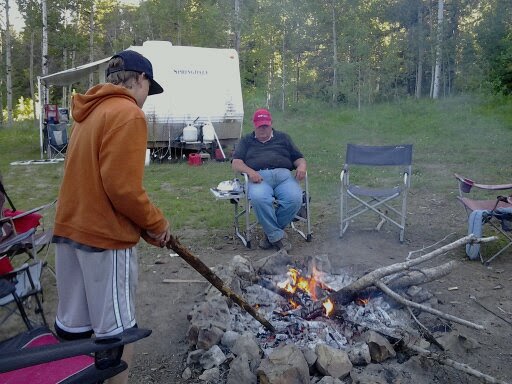
Dad and the boys are camping up in Cottonwood Canyon right now.  They left on Tuesday so I drove up yesterday to see how they're doing.  They're having a blast.  Dad told me he's really enjoying the boys.  Here's what we did last night and this morning.


First, Ethan and Burke took me on a hike.  The first stop was this beaver pond that is near the camp site.  


We played around at the beaver pond for a little while.


Then we hiked some more.


When we got back to camp, Taylor and Dad were working on the fire.  When it was ready we had . . .


s'mores!


When we finished with s'mores Dad put a hollow log they had found on the fire.  What a show!


Then we stayed up talking until dark.

This morning, after breakfast, we went for a drive.  At one point, there were rocks all over the road so the boys got out and moved them.  They had lots of fun.


This is what we saw at the end of the road:


After that, they fished in the beaver pond for a little while.


Then we played games for a while.  We played Would You Rather and laughed a lot.  I left at about lunch time.  It was great to see them having such a good time!

Friday, June 1, 2012

June Birthdays


Happy June birthday to:


Mom,


Steve,


Ethan,


and Cassidy.

I really hope I didn't forget anyone.  I can't find my calendar right now.  Happy birthday to all of you!  I hope you have a spectacular day!


Fast Fact Friday: Justin


Have you ever broken:

A window?
Yes, playing baseball.

A bone?
Nope. :)

Someone's heart?
Nope.  And never will.

Someone else's prized item?
Yep.  List is too long to write.

Your cell phone?
I went through about 6 chocolate phones.  Now I have the indestructible and I love it!

Fast Fact Friday: Ashley


Have you ever broken:

A window?
I don't think so?

A bone?
Yes.  My toe.  I was babysitting Burke and Annie and dropped a plate sideways on my middle toe.  It bruised all the way up to my ankle, and I could only wear flip-flops for a good month.

Someone's heart?
Yes.  I still feel terrible.  So I went on a date with a guy a few years back and I wasn't really interested , but kept on texting back to him to be nice.  I remember him asking me if we could be more than friends and I said no.  Which is fine, but it happened to be Christmas Eve.  I hope he still had a good Christmas.

Someone else's prized item?
I ran into Mom and Dad's house once . . . with their car.  

Your cell phone?
Hahaha.  I have sent one swimming in a toilet, sent them angrily flying through the air, chased kids in Shopko until it flew out of my pocket, bounced three times and shattered into pieces.  Interestingly, I have only ever broken one phone completely.